Студопедия Главная Случайная страница Обратная связь

Разделы: Автомобили Астрономия Биология География Дом и сад Другие языки Другое Информатика История Культура Литература Логика Математика Медицина Металлургия Механика Образование Охрана труда Педагогика Политика Право Психология Религия Риторика Социология Спорт Строительство Технология Туризм Физика Философия Финансы Химия Черчение Экология Экономика Электроника

Identifiers


The rules for identifiers given in this section correspond exactly to those recommended by the Unicode Standard Annex 31, except that underscore is allowed as an initial character (as is traditional in the C programming language), Unicode escape sequences are permitted in identifiers, and the “@” character is allowed as a prefix to enable keywords to be used as identifiers.

identifier:
available-identifier
@ identifier-or-keyword

available-identifier:
An identifier-or-keyword that is not a keyword

identifier-or-keyword:
identifier-start-character identifier-part-charactersopt

identifier-start-character:
letter-character
_ (the underscore character U+005F)

identifier-part-characters:
identifier-part-character
identifier-part-characters identifier-part-character

identifier-part-character:
letter-character
decimal-digit-character
connecting-character
combining-character
formatting-character

letter-character:
A Unicode character of classes Lu, Ll, Lt, Lm, Lo, or Nl
A unicode-escape-sequence representing a character of classes Lu, Ll, Lt, Lm, Lo, or Nl

combining-character:
A Unicode character of classes Mn or Mc
A unicode-escape-sequence representing a character of classes Mn or Mc

decimal-digit-character:
A Unicode character of the class Nd
A unicode-escape-sequence representing a character of the class Nd

connecting-character:
A Unicode character of the class Pc
A unicode-escape-sequence representing a character of the class Pc

formatting-character:
A Unicode character of the class Cf
A unicode-escape-sequence representing a character of the class Cf

For information on the Unicode character classes mentioned above, see The Unicode Standard, Version 3.0, section 4.5.

Examples of valid identifiers include “identifier1”, “_identifier2”, and “@if”.

An identifier in a conforming program must be in the canonical format defined by Unicode Normalization Form C, as defined by Unicode Standard Annex 15. The behavior when encountering an identifier not in Normalization Form C is implementation-defined; however, a diagnostic is not required.

The prefix “@” enables the use of keywords as identifiers, which is useful when interfacing with other programming languages. The character @ is not actually part of the identifier, so the identifier might be seen in other languages as a normal identifier, without the prefix. An identifier with an @ prefix is called a verbatim identifier. Use of the @ prefix for identifiers that are not keywords is permitted, but strongly discouraged as a matter of style.

The example:

class @class
{
public static void @static(bool @bool) {
if (@bool)
System.Console.WriteLine("true");
else
System.Console.WriteLine("false");
}
}

class Class1
{
static void M() {
cl\u0061ss.st\u0061tic(true);
}
}

defines a class named “class” with a static method named “static” that takes a parameter named “bool”. Note that since Unicode escapes are not permitted in keywords, the token “cl\u0061ss” is an identifier, and is the same identifier as “@class”.

Two identifiers are considered the same if they are identical after the following transformations are applied, in order:

· The prefix “@”, if used, is removed.

· Each unicode-escape-sequence is transformed into its corresponding Unicode character.

· Any formatting-characters are removed.

Identifiers containing two consecutive underscore characters (U+005F) are reserved for use by the implementation. For example, an implementation might provide extended keywords that begin with two underscores.


Дата добавления: 2015-09-07; просмотров: 471. Нарушение авторских прав; Мы поможем в написании вашей работы!


Аальтернативная стоимость. Кривая производственных возможностей В экономике Буридании есть 100 ед. труда с производительностью 4 м ткани или 2 кг мяса...


Вычисление основной дактилоскопической формулы Вычислением основной дактоформулы обычно занимается следователь. Для этого все десять пальцев разбиваются на пять пар...


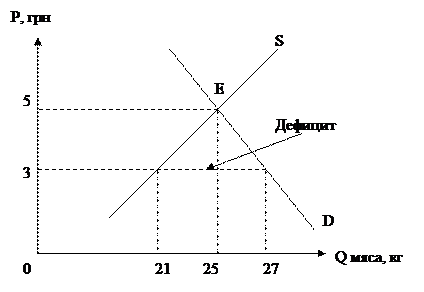
Расчетные и графические задания Равновесный объем - это объем, определяемый равенством спроса и предложения...


Кардиналистский и ординалистский подходы Кардиналистский (количественный подход) к анализу полезности основан на представлении о возможности измерения различных благ в условных единицах полезности...

Метод Фольгарда (роданометрия или тиоцианатометрия) Метод Фольгарда основан на применении в качестве осадителя титрованного раствора, содержащего роданид-ионы SCN...

Потенциометрия. Потенциометрическое определение рН растворов Потенциометрия - это электрохимический метод иссле­дования и анализа веществ, основанный на зависимости равновесного электродного потенциала Е от активности (концентрации) определяемого вещества в исследуемом рас­творе...

Гальванического элемента При контакте двух любых фаз на границе их раздела возникает двойной электрический слой (ДЭС), состоящий из равных по величине, но противоположных по знаку электрических зарядов...

Признаки классификации безопасности Можно выделить следующие признаки классификации безопасности. 1. По признаку масштабности принято различать следующие относительно самостоятельные геополитические уровни и виды безопасности. 1.1. Международная безопасность (глобальная и...

Прием и регистрация больных Пути госпитализации больных в стационар могут быть различны. В цен­тральное приемное отделение больные могут быть доставлены: 1) машиной скорой медицинской помощи в случае возникновения остро­го или обострения хронического заболевания...

ПУНКЦИЯ И КАТЕТЕРИЗАЦИЯ ПОДКЛЮЧИЧНОЙ ВЕНЫ   Пункцию и катетеризацию подключичной вены обычно производит хирург или анестезиолог, иногда — специально обученный терапевт...

Studopedia.info - Студопедия - 2014-2026 год . (0.055 сек.) русская версия | украинская версия