Symbols
Main article: Symbols of the United Kingdom, the Channel Islands and the Isle of Man
The Statue of Britannia in Plymouth. Britannia is a national personification of the UK. The flag of the United Kingdom is the Union Flag (also referred to as the Union Jack). It was created in 1606 by the superimposition of the Flag of England on the Flag of Scotland and updated in 1801 with the addition of Saint Patrick's Flag. Wales is not represented in the Union Flag, as Wales had been conquered and annexed to England prior to the formation of the United Kingdom. The possibility of redesigning the Union Flag to include representation of Wales has not been completely ruled out.[480] The national anthem of the United Kingdom is "God Save the King", with "King" replaced with "Queen" in the lyrics whenever the monarch is a woman. Britannia is a national personification of the United Kingdom, originating from Roman Britain.[481] Britannia is symbolised as a young woman with brown or golden hair, wearing a Corinthian helmet and white robes. She holds Poseidon's three-pronged trident and a shield, bearing the Union Flag. Sometimes she is depicted as riding on the back of a lion. Since the height of the British Empire in the late 19th century, Britannia has often been associated with British maritime dominance, as in the patriotic song "Rule, Britannia!". Up until 2008, the lion symbol was depicted behind Britannia on the British fifty pence coin and on the back of the British ten pence coin. It is also used as a symbol on the non-ceremonial flag of the British Army. The bulldog is sometimes used as a symbol of the United Kingdom and has been associated with Winston Churchill's defiance of Nazi Germany.[482]
Northern Ireland (Irish: Tuaisceart Éireann[3] [ˈt̪ˠuəʃcəɾˠt̪ˠ ˈeːɾʲən̪ˠ] ( Northern Ireland was created in 1921, when Ireland was partitioned between Northern Ireland and Southern Ireland by an act of the British parliament. Unlike Southern Ireland, which would become the Irish Free State in 1922, the majority of the population of Northern Ireland wanted to remain within the United Kingdom (see unionism and loyalism).[8] Most of these were the Protestant descendants of colonists from Great Britain. However, a significant minority wanted a united Ireland independent of British rule (see Irish nationalism and republicanism),[9][10][11][12] and most of these were Catholics. Today, the former generally see themselves as British and the latter generally see themselves as Irish, although some people from both communities describe themselves as Northern Irish.[13] Historically, Northern Ireland was marked by discrimination and hostility between these two communities in what Nobel Peace Prize-winner David Trimble called a "cold house" for Catholics. In the late 1960s, conflict between the two communities, and involving state forces, erupted into three decades of violence known as The Troubles, which claimed over 3,500 lives. The Good Friday Agreement in 1998 was a major step in the peace process although sectarianism still remains a major social problem. Northern Ireland has historically been the most industrialised region of the island. After declining as a result of the political and social turmoil of the Troubles in the second half of the 20th century, its economy has grown significantly since the 1990s. This is in part due to a "peace dividend" and in part due to links and increased trade with the Republic of Ireland. Prominent artists and sports persons from Northern Ireland include Van Morrison, Rory McIlroy, and George Best. Some from that part of the island prefer to define themselves as Irish (e.g., Seamus Heaney and Liam Neeson). Cultural links between Northern Ireland, the rest of Ireland, and the rest of the UK are complex, with Northern Ireland sharing both the culture of Ireland and the culture of the United Kingdom. In most sports the island of Ireland fields a single team, a notable exception being association football. Northern Ireland competes separately at the Commonwealth Games and athletes from Northern Ireland may compete for either Great Britain or Ireland at the Olympic Games.
|

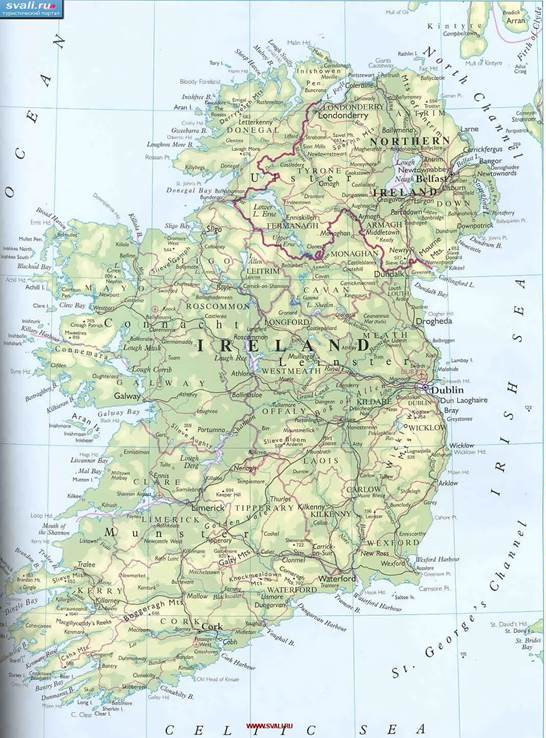
 listen); Ulster-Scots: Norlin Airlann or Norlin Airlan) is a part of the United Kingdom in the north-east of the island of Ireland. It is variously described as a country, province or region of the UK, amongst other terms.[4][5][6] Northern Ireland shares a border to the south and west with the Republic of Ireland. As of 2011, its population was 1,810,863,[2] constituting about 30% of the island's total population and about 3% of the population of the United Kingdom. Since the signing of the Good Friday Agreement in 1998, Northern Ireland is largely self-governing. According to the agreement, Northern Ireland co-operates with the rest of Ireland on some policy areas, while other areas are reserved for the Government of the United Kingdom, though the Republic of Ireland "may put forward views and proposals" with "determined efforts to resolve disagreements between [the two governments]".[7]