| Palace of Westminster
|
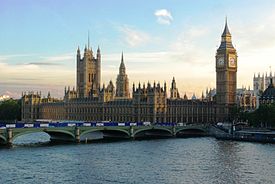 The Palace of Westminster with Elizabeth Tower andWestminster Bridge viewed from across the River Thames The Palace of Westminster with Elizabeth Tower andWestminster Bridge viewed from across the River Thames
|
| |
|
| |
|
| Built
| Middle Ages
|
| |
|
| |
|
| |
|
|
|
| |
|
|
| |
|
| |
|
Palace of Westminster is the meeting place of the House of Commons and the House of Lords, the two houses of the Parliament of the United Kingdom. Commonly known as the Houses of Parliament after its tenants, the Palace lies on the Middlesex bank of the River Thames in the City of Westminster, in central London. Its name, which derives from the neighbouring Westminster Abbey, may refer to either of two structures: the Old Palace, a medieval building complex that wasdestroyed by fire in 1834, and its replacement New Palace that stands today. For ceremonial purposes, the palace retains its original style and status as a royal residence.
The first royal palace was built on the site in the eleventh century, and Westminster was the primary London residence of the Kings of England until a fire destroyed much of the complex in 1512. After that, it served as the home of Parliament, which had been meeting there since the thirteenth century, and the seat of the Royal Courts of Justice, based in and aroundWestminster Hall. In 1834, an even greater fire ravaged the heavily rebuilt Houses of Parliament, and the only structures of significance to survive were Westminster Hall, the Cloisters of St Stephen's, the Chapel of St Mary Undercroft and the Jewel Tower.
The subsequent competition for the reconstruction of the Palace was won by architect Charles Barry and his design for a building in the Perpendicular Gothic style. The remains of the Old Palace (with the exception of the detached Jewel Tower) were incorporated in its much larger replacement, which contains over 1,100 rooms organised symmetrically around two series of courtyards. Part of the New Palace's area of 3.24 hectares (8 acres) was reclaimed from the Thames, which is the setting of its principal façade, the 266-metre (873 ft) river front. Barry was assisted by Augustus W. N. Pugin, a leading authority on Gothic architecture and style, who provided designs for the decoration and furnishings of the Palace. Construction started in 1840 and lasted for thirty years, suffering great delays and cost overruns, as well as the death of both leading architects; works for the interior decoration continued intermittently well into the twentieth century. Major conservation work has been carried out since, due to the effects of London's air pollution, and extensive repairs took place after the Second World War, including the reconstruction of the Commons Chamber following its bombing in 1941.
The Palace is one of the centres of political life in the United Kingdom; "Westminster" has become a metonym for the UK Parliament, and the Westminster system of government has taken its name after it. The Elizabeth Tower, in particular, which is often referred to by the name of its main bell, "Big Ben", is an iconic landmark of London and the United Kingdom in general, one of the most popular tourist attractions in the city and an emblem of parliamentary democracy. The Palace of Westminster has been a Grade I listed building since 1970 and part of a UNESCO World Heritage Site since 1987.